Pages

31 July 2010

Pourgouri (Bulgar wheat)


Tired of the same old side dishes? Rice, pasta and potatoes just not exciting anymore? I know how you feel. You want something to complete the meal that will compliment the meat and veg and not take too long to prepare. Enter pourgouri, or Bulgar wheat.

Bulgar wheat is probably found in the staples or bulk food area of the grocery store. In London it can be found near the other beans and pulses because they have their own area of the store as so many more cultures eat beans and pulses compared to the American diet. Bulgar wheat can even be found in corner shops sometimes!

Bulgar wheat is like very small, coarse rice granules, or even a bit like quinoa (which I have never found in London and if anyone knows of a secret stash, do tell!). It's very filling and delicious with Greek yogurt on the side and goes well with pork or chicken. I have never heard of it or tried it until I met my fiance, like so many other dishes and foods.

This dish is traditionally made over the stove, but can now be made in the microwave, as my mother-in-law showed me.

First, chop an onion and put it into a big microwave-safe bowl with 2-3 Tablespoons of vegetable or olive oil. Microwave for 1-2 minutes on a high heat.


Then add small bits of vermicelli noodles- about 1.5 cups. You could use thin spaghetti if you were in a pinch. Microwave for 3-4 minutes on a high heat or until the onions and vermicelli are a bit browned. If your microwave is less powerful, try 7-10 minutes.


Add a can of chopped tomatoes, 1.5-2 cups bulgar wheat and enough water to cover everything. Microwave for 20 minutes or until the water is absorbed and the wheat is soft. If you need to, add more water and keep cooking.


That's it! An easy Greek side dish to liven up your dinner.


UPDATE: For a great salad recipe and tips on where to find quinoa, check out a great London blog, The Bittersweet City.

26 July 2010

Summer quiche and pie crust


I know that summer is not the usual time when people want to get into the kitchen and bake, but all of the summer bounty of vegetables and fruit incite in me a desire to try new things no matter the temperature. Though it has been warm and sunny in London this summer, enough that it actually feels like a summer, I know it is nowhere near the usual summers in the southern US. Still, a girl can dream and go along with season appropriate food, like quiche. Quiche can be eaten hot or cold and can incorporate all sorts of summer flavours which means it is the perfect, easy food for lunch or dinner.

Another great thing about quiche is I have the chance to make pie crust, one of my most favorite things to make. I know that many people have trouble with shortcrust dough as it is persnickety and often fickle in temperament. It can get that way sometimes for me too. Pie dough was one of the first things that my grandmother taught me to make and to me it is calming to mix, roll and shape the dough into a pie pan. Plus, when you get it right there is a sense of accomplishment when something so simple comes together to make a pretty dish.

Quiche was surprisingly easy to make, or at least the pared down version of the recipe I actually used. I used the pie crust recipe from grandma, which is 1/2 cup butter, 1 1/4 cups flour, dash of salt and 2-3 Tablespoons of cold water. When the dough forms a ball, sprinkle flour on a counter top or board and on the dough ball as well to begin rolling the pie crust.


Roll in many directions until you have a vaguely roundish shape larger than your dish.


Transferring the rolled crust to the pie dish should not break the crust if the dough is right. If you fold the rolled crust in half and move it to the dish, it should unfold nicely without any tears or dropped bits.


Then I pressed the dough into the pie dish and ran a knife around the top to cut off the excess dough, (Save this for another tasty treat below!) then pinched the top to give it a finished edge. This also helps keep things in the dish.


After parbaking the pie crust for about 8 minutes, I lined it with sliced courgettes and tomatoes and I was trying to make this quiche presentable. You can probably just throw some veggies into the crust and it will taste just as good, but sometimes you want the food to look just as good as it tastes.


I combined three eggs, maybe 1/4 cup single cream, salt, pepper and 1/4 cup chopped fresh basil and poured it on top of the veggies in the pie crust.


A sprinkling of parmesan cheese on top and into the over for 30 or so minutes on 375 F/180 C.


And it comes out looking so pretty!


Now what about that extra dough I hear you say?

When Grandma taught me to make pie dough, we would always have some left over from the crusts we were making. With the extra dough Grandma would make something she called a sugar packet, which I think she picked up from her mother. Basically, you roll out a tiny crust and fill the inside with sugar and cinnamon, then fold it over like a turnover and bake. The best part is to eat the sugar packet warm so the cinnamon-sugar mixture is still warm and gooey.


Dinner and dessert all in one pie crust!

21 July 2010

Veggie crisps


One of the best places to really experience a new country and culture is to visit the grocery store. This is where the normal people who live in the country or city of interest shop and I often find it is a more realistic reflection of the country's eating habits. I also love going to grocery stores on a normal day so of course I make an effort to visit them in other countries.

When I first came to the UK my then-boyfriend-now-fiance introduced me to vegetable crisps, which are essentially the same thing as potato crisps/chips, but made out of root vegetables. It sounds really weird but it works! I always wondered why I had never seen these in the American grocery stores, but it could be because the crisps/chips area is a whole aisle in the typical US grocery store and it is easy to miss one type of chips when there are cheetos and corn chips and pringles and pretzels and ruffles and . . .

It could also be that they had not arrived in the southern US grocery stores five years ago, but it looks like they have now. My mom mentioned them the other day with skepticism until I talked her into trying them. (I think the parsnips put people off.) She was looking for a decent gluten-free snack and they seem to be few and far between in small town USA or very expensive or both. Being the good daughter I am, I decided to try to make vegetable crisps to see if I could save my mom some money and have a healthy, tasty snack. Plus, I like them too.

The process to make veggie crisps is very much like making potato crisps. You need something to slice your root veggies very thinly and I used a mandolin. Not the type that is often used in folk music, but the stand that will slice veggies very thinly while trying to slice your fingers too.

First, slice some root vegetables into thin strips. I tried carrots, parsnips and beets but you could easily try sweet potatoes and squash if you were feeling adventurous. I found that it was best to slice the carrots and parsnips on an angle so you get long thin strips.


The next bit was a trial and error process. I coated the carrots with olive oil and salt, but perhaps a bit too much oil. The carrots did not get as crispy as I wanted so a little less oil would be better. Just a tiny splash so they do not stick to the pan would be sufficient.


Once you have oiled and salted the veggies, spread them out on a baking pan and put them into an oven on a low heat, about 150 C or 300 F. You will need to leave them in there for 1.5-2 hours, turning once or twice to make sure they don't stick. I decided to oven bake them as opposed to deep frying them to try to keep them slightly more healthy.


Because of the excess oil, I dumped the crisps on to a paper towel to dry after they were cooked.


Voila! Healthy and tasty veggie crisps for my lunch.


Now that I have tried this once, it would be really easy to do again. The slicing part takes the most time but once that is done just spread on baking pans and leave to cook for a while. I might even try to tweak the recipe and cooking time as the beets are a little too done. You could probably do lots of batches of these and keep them in airtight containers to munch on. Oh, and these are gluten-free as far as I can tell so you can make them for all your gluten-free friends.

15 July 2010

The Joy of Cooking

Meatloaf- what could be more American than that? I am rustling up dinner tonight and turned to my new cookbook, The Joy of Cooking. It is a classic of modern American cooking that my mom gave to me (well, technically us) for our engagement, just as her mother gave it to her. It is truly a seminal cookbook as it explains everything from the most ordinary kitchen techniques and dishes to very complicated ones. The book is perfect for those times when you know what you want but aren't quite sure how to make it, or need to look up the quantities of ingredients. It's not too bad for handy recipes too.


I knew I wanted to make meatloaf tonight and knew what I had seen my mom and dad put in it before, but I turned to my trusty old cookbook friend for exact guidance. Turns out my memory of the dish and the cookbook are really similar!

Here's the modified Joy of Cooking meatloaf recipe for a quick American dinner on a weeknight:

1 pound ground beef/mince meat
1-2 eggs, depending on how eggy you want it to be
1/2-3/4 bread crumbs
3 Tablespoons Worcestershire sauce
half a chopped onion or dash from a package of onion soup mix
salt
pepper

I also like the suggestion of adding ketchup, barbeque sauce, mustard or horseradish to the mixture, though I usually just add ketchup or barbeque sauce on top.

I also will serve fresh green beans, french fries and have peanut butter cookies for dessert. I went all out for tonight's American dinner.


**Sorry for the lack of pictures but I used an older camera as my regular one wasn't around, and now all the pictures have come out fuzzy. When I make meatloaf again, I'll show you what it looks like! **

6 July 2010

4th of July


Two days ago it was the fourth of July, just a normal Sunday in London. In the US, it was the anniversary of the beginning of the country and generally the most patriotic day of the year. I don't know any other country that really celebrates the country, the foundation, the ideals and the current citizens as much as the US, especially through the emblem of the flag. Is there another country that places such meaning in and reveres such an object? From the outside I have been able to appreciate the core meaning of Independence day more than I was able to while in the country. My fiance and I listened to a reading of the Declaration of Independence, the reason for the celebration, and discussed (briefly) the pros and cons of the US in the world. We also indulged in the typical American fourth of July: enjoyed the sunshine, ate hamburgers and great American summer food, and reveled in the day off of work. A few fireworks, maybe a parade and some march songs and it could have been a day in the US.

That's a bit unjust of me. The fourth also has a great feeling of community and pride in your country. People are generally happy, kind and get into the spirit of the celebration, which of course was lacking in the UK as we were some of the few people celebrating anything.

Although the fourth, more than any other American holiday, should be associated with the US, it has never been a huge holiday for me (unlike, say, Thanksgiving). I worked for the past 6 or so summers I was in the states so I missed a lot of the festivities. When I was younger we would have firework shows in the backyard and a cookout and maybe go to a local parade, but I don't really have great feelings towards this holiday. Well, I miss spending the day with my family, and fireworks. But I can now appreciate the ideals of the day from the outside and reflect on the birth of the US. And maybe next year I will have fireworks.

In keeping with the American theme of the day, I made rice krispy treats which to me is a classic American dessert. It turns out though that in the UK, they are called rice krispy cakes and made with chocolate, not marshmallows. Scandalous! I obviously had to show my fiance the correct way of making rice krispy treats, which is shamefully easy to make but I will include instructions in case any British comrades would like to try it.

Melt 4 Tablespoons of butter and a package and a bit of marshmallows in the microwave (told you it was shamefully easy).


The marshmallows come in white and pink here, hence the weird pinkish color when melted. Also, note the penguins diving into the marshmallows!


Stir in about 6 cups of rice krispies....


Until they are coated in sticky loveliness.


Press them into a rectangular pan and wait until they are cool.


Cut into squares.


Decorate as you see fit. I didn't have any blue icing, so we decorated with fireworks and a star.


Happy belated fourth of July!

30 June 2010

A very English summer


I have figured out a few things in the past couple of days:

1) The official start of seasons always seemed off to me, living in the southern US, but this year it all makes perfect sense. As if on cue, the weather has changed in the UK to accommodate the official calendar start of seasons. It doesn't always happen this way, but this year we are experiencing all four (!) seasons in London. Right now, we are on summer and actually have the heat and sunshine to prove it! I'm not a huge fan of hot weather, though I appreciate actually having the seasonal weather to match the time of year.

2) I like tennis. We went to the Wimbledon tournament this past weekend and saw some great athletes. Though the day was long, I really got into the tennis. Previously, Wimbledon would be something I would flick past on a Saturday afternoon and watch for a little while if it was an exciting game, nothing more. Now, I might pay more attention to the sport, or at least during Wimbledon.

3) We indulged in two of the the three things that are the epitome of an English summer: Pimm's and lemonade and strawberries and cream. (The other is barbecues.) Ok, the strawberries and cream might be specific to Wimbledon, though strawberries have been flooding the grocery stores for the past month and continue to do so throughout summer.

As there have been so many strawberries around, I have wanted to do something with them. But they never seem to last long around me. I (almost) literally wolf them down with a drenching of cream, or dip them in powdered sugar.


I sincerely love strawberries and eating them with cream just seems to make me think of the carefree days of summer during childhood, a light summer breeze and dappled sunshine, tea parties and sun dresses. Maybe it is that strawberries and cream is so pure and good without needing anything else save a splash of sugar that throws me back to a playful and younger state, days when the sunshine meant playtime.


This is most definitely my dessert of choice for the English summer.

20 June 2010

Stuffed peppers


My family had the most internationally influenced food of anyone I knew growing up, second only maybe to those who had emigrated from another country. We would have stir fry, black beans and rice, meat and potatoes, schnitzel, lasagne, fondue, and stuffed peppers among other things. I never knew that these dishes all had different food heritage and this was all very normal to me. Once I started to make my own food and tried to find recipes to recreate some of these dinner staples in my household, I learned how worldly the selection was. OK, not everything was authentic and maybe the recipes were tweaked to suit our tastes, but still, for a family from the Midwest that grew up on (red) meat and potatoes, we were the pioneers of cultural expansion through food in my eyes.

Two examples spring to mind that are somewhat relevant. One Thanksgiving, a traditional time of eating very American foods like turkey, potatoes and apple pie, my mom had some of her Chinese students and friends from graduate school over as they had no where to go for the day. In return for the hospitality, they showed us how to make authentic Chinese eggrolls from scratch. It's a really fun memory for a four year old to have of carefully rolling the wraps and sealing with egg, then hearing the eggrolls cook in hot oil.

The other memory is from high school. We had three acres of land at the time and we grew a lot of vegetables. My dad always planted tomatoes and we would can and freeze most of them to eat throughout the year, as we did with the beans, peppers, peas, squash and apples that were the main staples of the garden. Taking the garden produce as a cue, I decided to have a party. A usual pizza and music party like other 17 year olds? No, I had an Italian food themed party, including caprese salad, a frittata, pasta with fresh vegetables and lots of tomatoes, complete with a table outside on the porch to give the party an Italian summer feel.

The other day, I decided the I wanted to make stuffed peppers, one of my favorite dishes growing up and one I would request to have made on my birthday (that, and lasagne). I told my fiance what we were having for dinner and he perked up, thinking I was making the Greek stuffed peppers dish. What? I had no idea this was a Greek dish too! I looked up the recipe in the Greek cookbook I have and the funny thing is that the recipes are very similar to a point. The Greek recipes calls for the seminal ingredients of any good Greek dish, tomatoes and cinnamon, while mine does not. Still, I think it is interesting that we have been eating almost the same dish thousands of miles apart for so many years. Maybe, if everyone had access to all the food ingredients out there, we would all come up with generally the same dishes, like when pre-historic humans all created art at the same time across the world. Maybe all people do crave similar textures and tastes in food.

Below is what I did for my recipe of stuffed peppers, but at the end I will also include the Greek variations.

I sauteed some (about 500 grams) mince meat and half an onion, then threw in chopped mushrooms and courgettes. You can also add any extra peppers or leave all veggies out.


While the meat mixture is cooking, I cut up the peppers for stuffing. This is a very particular way to cut them so that only the top comes off. You start by cutting around the stem but not too deeply or you will have holes in your pepper!


Pull out the stem and clean out any seeds by washing it out with water- much easier than getting seeds one by one.


Pretty hollow peppers.


Add rice and water to the meat mixture. I usually have a 2/3 rice to 1/3 meat ratio, but it depends how meaty you are feeling to how much rice you add.


While the rice/meat mixture is cooking, bring a large pot of water to boil for the peppers. Place all the peppers in the pan, submerged with water, for which I use tongs of some sort that I can find.


After only 7 or so minutes, or until the peppers are tender but not falling apart, drain the water from the pot and each pepper, pull the peppers out and place in an oven-proof dish.


Now that the rice mixture is done, fill the peppers! Don't be shy, fill them to the brim!


When all the peppers are full, place them in a hot oven (maybe 180C, 250 F?) for about 15 minutes, then top with cheddar cheese.


In the Greek version of this dish, you do not add veggies and Worcestershire sauce to the rice mixture and should add cinnamon and chopped tomatoes instead. You can also stuff practically anything- courgette, pepper, tomato, aubergine. If you can hollow it, you can stuff it.

I think this is truly a dish that comes from both the (now) Greek and American food sides of me, without even knowing it all those years.

15 June 2010

Similar beans


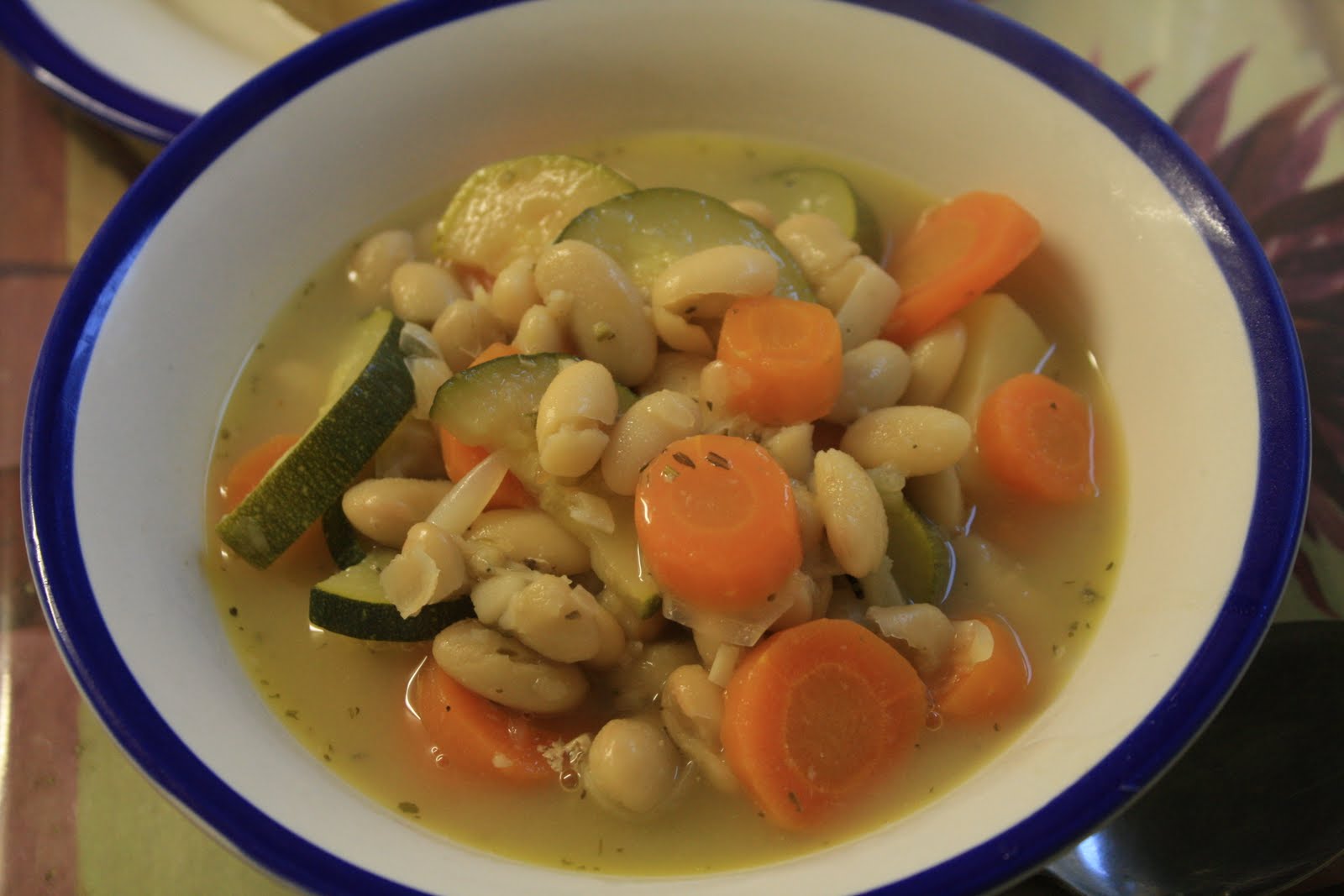
Sorry for the brief hiatus, but my mom was in town and lots of recent family functions with lots of food have not left me much time to cook. When I did get back into it last night, I threw together some things I had and ended up with a Tuscan bean casserole of sorts (I changed the recipe I was using as a guide). Perhaps it was the exact type of beans I used, but this supposedly Italian-based dish ended up tasting like a Greek dish my fiance loves, only with some garlic, onion, and herbs de provence added.

That got me thinking about the similarities in foods between cultures. I suppose that with Italy and Greece and Cyprus all being on (in) the Mediterranean it is not a stretch to see the similarities in climate, foodstuffs available and dishes that are made. It is also not surprising to find that traditional America and the Mediterranean have vastly different food styles due to the distance between them, different climates and landscapes and different foodstuffs available. It makes me chuckle when a certain dish is touted as a specialty of an area when it is exactly the same dish as one from the next area over but with an added spice. Granted, adding some spices do change the taste of dishes completely, but when you get down to the basics, a lot of dishes have some very core similarities.

Or as my grandfather puts it, all dishes are made of the same stuff but in different forms.

So this is my Tuscan bean casserole that is very similar to Cypriot fasolia. I was hungry so I did things the fast and easy way.

Brown two prokchops in a little olive oil in a large pot. A blue pot, if you have one, is preferable.


Then add chopped carrots, onion quarters, and canned cannellini beans with juice over the pork.

I added two cloves of roughly chopped garlic. Mmmm, garlic. This may be one of two elements that makes this dish 'Tuscan', so don't be stingy with it.

Sprinkle some herbs de provence on top of it all. You could also use just rosemary, thyme or combination of whatever herbs you would like, but I like them all so herbs de provence it is!


Cover this mixture with water and simmer for about half an hour, and I then added some chopped courgette and a few potatoes to the mixture. At some point, I also added salt and pepper.


Simmer for another 15 or so minutes and then check the pork to make sure it is done and all the veggies are nicely boiled. The water also thickens as it cooks and makes the whole thing like a soup.


The aroma is mouth-watering. And the pork is very tender and juicy.

I think to be inclusive, I wil say this is a great Mediterranean dish and continues my love affair with cannelini beans. I think these have another name in the American lexicon, but I can't remember what they are. Still, they're great and tasty.

I shall leave you with this: Beans of a feather, stick together.

Here's the rough ingredient list:

2 Tbsp. olive oil
2 porkchops
3 chopped carrots
3 small onions (1 large onion), quartered
2 cans cannelini beans
2 cloves chopped garlic
1 chopped courgette
2 handfuls peeled and large cubed potatoes (exact measurements aren't my thing)
2 tbsp herbs de provence, or other herbs and spices you like
water to cover mixture
salt and pepper to taste